Normal Heights Divorce Attorney
Experienced Normal Heights Divorce Attorney for Family Law Representation
If you are looking for a Normal Heights divorce attorney, having the right legal team makes a real difference. At Doppelt and Forney, we provide strategic, personalized family law representation for Normal Heights residents and their families.
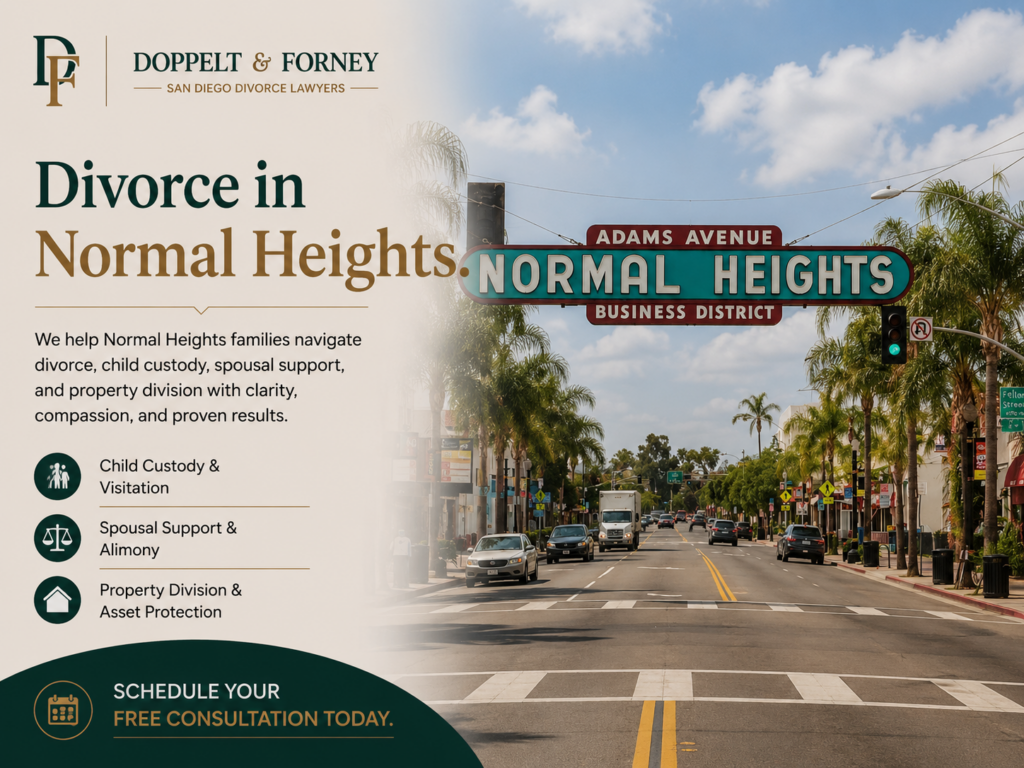
Normal Heights is one of San Diego's most densely populated and community-oriented urban neighborhoods. Situated between Adams Avenue to the north and El Cajon Boulevard to the south, it stretches along one of the city's most celebrated independent business corridors. Adams Avenue is home to a long-established strip of independent bookstores, record shops, vintage boutiques, coffee houses, and restaurants that have defined the neighborhood's character for decades. Normal Heights attracts a diverse mix of longtime residents, young families, musicians, artists, small business owners, and professionals who value its walkability, community identity, and central location. A Normal Heights divorce attorney at our firm understands that cases here reflect this diversity. They range from renters and early-career households with modest assets to small business owners along the Adams Avenue corridor and long-term homeowners with significant equity and complex financial histories.
Which Courthouse Handles Your Case?
Normal Heights residents file all family law pleadings at the Central Courthouse at 1100 Union Street in downtown San Diego. Normal Heights sits just a few miles from the courthouse via Adams Avenue or the I-805. Our attorneys appear regularly at the Central Courthouse. We know its local procedures, judicial expectations, and how cases move through the system there.
We also serve clients in nearby communities including North Park, Hillcrest, South Park, Golden Hill, and throughout San Diego County.
Our Family Law Services in Normal Heights
We represent Normal Heights clients across the full range of family law matters. Normal Heights divorce cases reflect the neighborhood's diverse economic profile, from straightforward uncontested divorces to cases involving small business ownership, bungalow court properties, and contested custody disputes with school continuity considerations.
Divorce and Separation Services
Divorce and Legal Separation — We guide clients through every stage of the process. Before filing anything, we help you understand the full legal and financial implications of your decision.
Legal Separation — For clients who are not ready to divorce, legal separation allows the court to address property, support, and custody while the marriage remains legally intact.
Custody and Support Services
Child Custody and Visitation — We help clients build parenting plans focused on the best interests of their children. We also prepare clients thoroughly for Family Court Services mediation and contested custody hearings at the Central Courthouse.
Child Support — For Normal Heights residents with small business or sole proprietor income along the Adams Avenue corridor, accurately documenting income for the guideline calculation requires specific analysis.
Spousal Support — We advise clients on both temporary and long-term spousal support strategy under California Family Code Section 4320. Our office uses the same XSpouse program that San Diego Family Law Court judges use. This allows us to calculate guideline temporary spousal support so clients make informed decisions about support amounts both before and after judgment.
Property, Protection, and Post-Judgment Services
Property and Asset Division — Normal Heights properties have appreciated significantly over recent decades. We analyze community and separate property carefully, identify reimbursement claims, and ensure all assets and debats receive accurate treatment in the division process.
Domestic Violence Restraining Orders — We advise victims on their legal options. This includes how to file for a Temporary Restraining Order and how a domestic violence finding affects custody outcomes under California law.
Enforcement of Court Orders — When someone violates a court order on support, custody, or property transfer, we take the appropriate legal steps to enforce your rights.
Post-Judgment Modifications — We handle modifications to custody, visitation, and support orders when a material change in circumstances warrants revisiting the existing order. The legal standard that applies depends on whether orders are temporary or permanent and whether the case is pre-judgment or post-judgment.
What Makes a Normal Heights Divorce Case Distinctive
Pre-Judgment and Post-Judgment Custody Modification Standards
One of the most practically important distinctions in any Normal Heights custody case involves whether a modification request arises before or after the court enters a final judgment. Many Normal Heights clients come to us mid-case, after temporary orders have been entered but before the case has been fully resolved. Others return after judgment seeking to modify an existing permanent order. The legal standard that applies differs significantly between these two situations.
Before judgment, the court has broad discretion to modify temporary custody orders based on changed circumstances or simply because a different arrangement better serves the child's interests. The threshold for modification is lower before judgment than after. After the court enters a permanent custody order, California courts apply the more demanding standard established in Montenegro v. Diaz. Under that standard, the party seeking modification must show a significant change of circumstances that affects the welfare of the child. Courts will not reopen a settled permanent custody determination simply because one parent prefers a different outcome.
Understanding which standard applies to your situation matters significantly before deciding whether to file a modification motion. Filing a post-judgment modification motion without meeting the Montenegro threshold can damage your credibility with the court. It can also make a future meritorious request harder to bring. Our attorneys analyze where each Normal Heights case stands procedurally before recommending any custody modification filing.
Adams Avenue Small Business Ownership
Normal Heights has a thriving independent business community centered on Adams Avenue. Some Normal Heights residents own or co-own small businesses along this corridor, including retail shops, food and beverage establishments, service businesses, and creative studios. When a marriage ends and one or both spouses have an ownership interest in an Adams Avenue business, that interest requires valuation and treatment as part of the property division process.
Valuing a small independent business on Adams Avenue differs from valuing a larger commercial enterprise. Many Adams Avenue businesses are sole proprietorships or small partnerships where the owner's personal goodwill, meaning their relationships, reputation, and skills, drives a significant portion of the business value. California courts distinguish between personal goodwill, which belongs to the individual and is not community property, and enterprise goodwill, which attaches to the business itself and may be community property subject to division.
Drawing this distinction accurately requires specific analysis of how the business generates its revenue, how dependent that revenue is on the personal relationships and efforts of the owner spouse, and what the business would be worth to a hypothetical third-party buyer. Our attorneys work with business valuators experienced in small independent businesses when a Normal Heights case involves Adams Avenue business ownership.
Bungalow Courts and Shared Property Structures
Normal Heights contains a notable inventory of bungalow courts, which are historic groupings of small individual bungalows arranged around a shared courtyard built primarily in the 1920s and 1930s. Some Normal Heights residents own entire bungalow courts as investment properties. Others own individual bungalows within larger shared structures. Both ownership situations present specific legal challenges in a divorce.
For a Normal Heights resident who owns an entire bungalow court, the property functions as an income-producing investment requiring the income approach to valuation in addition to standard residential comparables. Current lease terms, vacancy history, rental rates relative to market, and the condition of individual units all affect the income approach analysis. The community property rental income from the bungalow court also factors into support calculations during the marriage and must be accurately documented in the financial disclosures.
For a resident who owns an individual bungalow within a shared structure, questions arise about shared maintenance obligations, common area responsibilities, and how the ownership interest gets transferred or sold in a division. These structural ownership issues need specific attention in the settlement agreement to avoid enforcement problems after judgment.
School Continuity and Custody in Normal Heights
Normal Heights sits within the San Diego Unified School District and feeds into several well-regarded neighborhood schools. The neighborhood's density means that children often attend schools within walking distance of their home and develop close friendships with neighbors who attend the same schools. When parents separate and one considers relocating outside the Normal Heights attendance area, school continuity becomes a central issue in the custody analysis.
California courts weigh a child's established connections to their school community as part of the best interests analysis. For Normal Heights children who have spent multiple years in the same school building, developed friendships with neighborhood classmates, and participate in school-based activities, maintaining that continuity carries real weight. A parenting plan that allows both parents to remain near the Normal Heights school community while dividing parenting time meaningfully is the goal our attorneys work toward in every Normal Heights custody case involving school-age children.
Why Clients Choose Doppelt and Forney
Family Law Only. Our practice focuses exclusively on family law. That specialization produces deeper expertise and sharper strategy on every issue in your case.
Central Courthouse Experience. Our attorneys appear regularly at the Central Courthouse in downtown San Diego. We know its procedures, judicial expectations, and how to move cases forward efficiently there.
Pre-Judgment and Post-Judgment Custody Analysis. Understanding which legal standard applies to your custody situation before filing any motion is essential. We analyze this question specifically in every Normal Heights custody case.
Adams Avenue Business Valuation Experience. Small independent business ownership along Adams Avenue creates specific personal goodwill versus enterprise goodwill valuation questions. We address these issues accurately and thoroughly.
Accurate Support Calculations. We use the same XSpouse software that San Diego Family Law Court judges use. This gives Normal Heights clients accurate support estimates before any hearing and a realistic foundation for settlement discussions.
Clear and Responsive Communication. We keep you informed throughout your case and answer your questions promptly. Both in-person and virtual appointments are available.
Written Service Guarantee. We put our commitment to you in writing. Few family law firms offer this level of accountability.
Free Confidential Consultations. Your first consultation runs up to 30 minutes. It is free, confidential, and takes place with a licensed California attorney.
Frequently Asked Questions About Normal Heights Divorce Cases
Where do Normal Heights residents file for divorce?
Normal Heights residents file all family law pleadings at the Central Courthouse at 1100 Union Street in downtown San Diego. Our Normal Heights divorce attorney team appears regularly there and understands its local procedures and judicial expectations.
How does the divorce process begin in Normal Heights?
The first formal step is filing the FL-100 Petition for Dissolution of Marriage at the Central Courthouse and serving it on the other party. Service triggers California's mandatory six-month waiting period. After that period ends, the court can finalize the divorce. Both parties must also complete and exchange mandatory financial disclosures. These include the Schedule of Assets and Debts and the Income and Expense Declaration. Our preparation for initial consultation page outlines what financial documents to gather before your first meeting.
What is the difference between pre-judgment and post-judgment custody modification?
Before the court enters a final judgment, temporary custody orders carry a lower modification threshold. The court has broad discretion to adjust them based on the child's best interests. After the court enters a permanent custody order, the Montenegro v. Diaz standard applies. The party seeking modification must show a significant change of circumstances affecting the child's welfare. Understanding which standard applies to your situation is essential before filing any modification motion. Our attorneys analyze this question specifically before recommending any custody filing.
How does the court handle property division if Normal Heights spouses cannot agree?
When parties cannot reach a property division agreement, the court divides community property equally under California law. All assets and debts must be fully disclosed on the mandatory financial disclosure forms. The court then determines the character of each asset as community or separate property and orders an equal division of community assets and debts. Our attorneys help Normal Heights clients reach agreements that reflect what the court would order rather than pursuing outcomes that litigation cannot reliably achieve.
How are Adams Avenue small businesses valued in a Normal Heights divorce?
Valuing a small Adams Avenue business requires distinguishing between personal goodwill and enterprise goodwill. Personal goodwill belongs to the individual owner and is not community property. Enterprise goodwill attaches to the business itself and may be community property subject to division. Drawing this distinction requires specific analysis of how the business generates revenue and how dependent that revenue is on the owner's personal relationships and skills. Our attorneys work with business valuators experienced in small independent businesses when Adams Avenue ownership is at issue.
How does school continuity affect custody decisions in Normal Heights?
California courts weigh a child's established connections to their school community as part of the best interests analysis. For Normal Heights children with strong ties to their neighborhood school, maintaining that continuity carries real weight. When one parent considers relocating outside the Normal Heights attendance area, the impact on the child's school community becomes a central issue in parenting plan negotiations. Our attorneys build parenting plans that address school continuity specifically in every Normal Heights case involving school-age children.
Can custody arrangements change over time in Normal Heights?
Yes. Either party can ask the court to modify custody when circumstances change. The applicable legal standard depends on whether the case is pre-judgment or post-judgment and whether existing orders are temporary or permanent. Before judgment, the threshold is lower. After the court enters a permanent order, the Montenegro v. Diaz standard requires a showing of significant changed circumstances affecting the child's welfare. Our attorneys analyze which standard applies before recommending any modification filing.
Schedule a Consultation With a Normal Heights Divorce Attorney Today
Contact Doppelt and Forney today to schedule your free consultation. We represent clients throughout Normal Heights and all of San Diego County and offer both in-person and virtual appointments.